Some gear stays in rotation because it solves a real problem without creating new ones. That is basically how the BLUETTI AC180 Portable Power Station has been for me.
I have owned it for about two years, and I use it mainly as my main power source at the tent site. In a typical year, it comes with me for roughly 20 to 30 camping days, usually on trips lasting 2 to 7 days. My use is pretty consistent: it powers an Arebos 47L compressor cooler and a Starlink Mini around the clock, and during the day I usually pair it with a BLUETTI MP200 folding solar panel.
So this is not a review based on a weekend of feature testing. It is based on repeated use with the same setup, enough times that the AC180’s strengths and weak points are very clear to me.
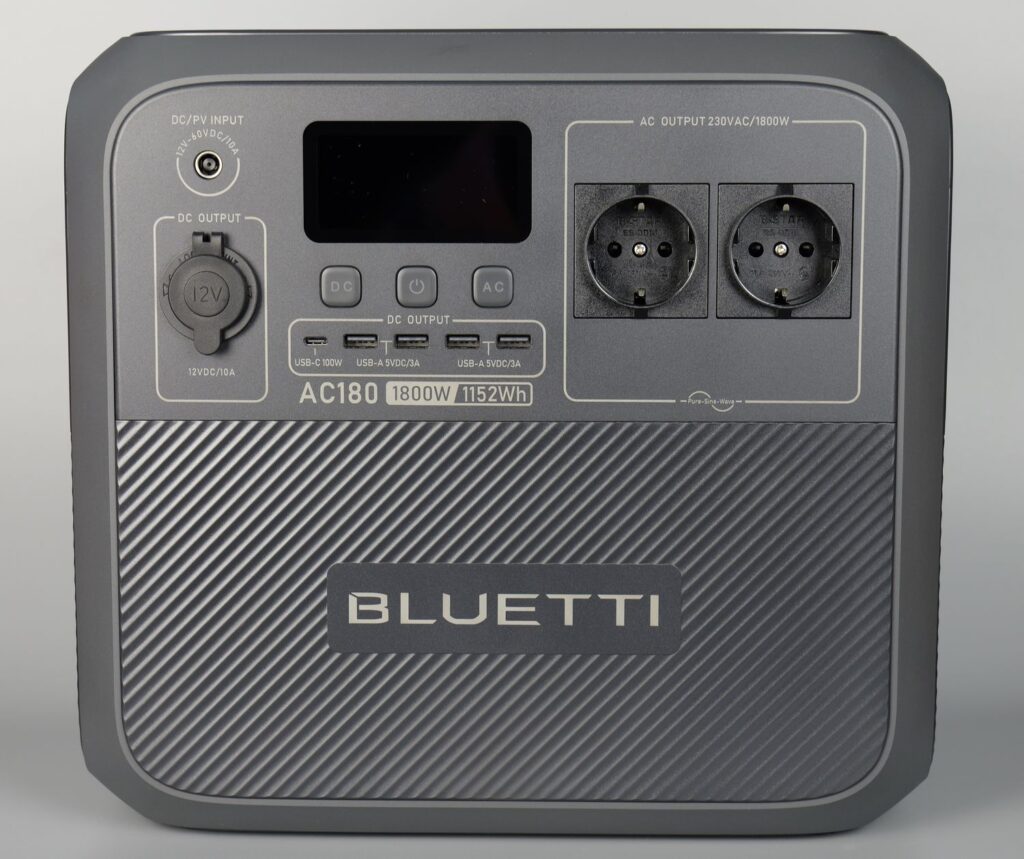
On paper, the AC180 is a 1152Wh LiFePO4 power station with 1800W AC output, 2700W Power Lifting Mode, up to 500W solar input, and a weight of about 16 kg / 35.3 lb. In practice, what has mattered more to me is where it fits well: car camping, base-camp use, and short home outages.
The tradeoff is obvious too. This is not a light, casual thing to carry around all day.
Quick verdict
If I had to sum up my experience quickly, it would be this:
– The AC180 has been a very good fit for my car-camping and base-camp setup
– My real use is mainly DC-heavy: Arebos 47L cooler on 12V and Starlink Mini usually on USB-C
– In my setup, the AC180 is often at about 40 to 50% in the morning
– On a good day, the BLUETTI MP200 usually brings it back to full during the day, even with those loads still connected
– I typically see around 170W solar input at first in good sun, then more like 140 to 150W once the panel gets hot
– On rainy or cloudy days, I have to conserve power
– Wall charging has been excellent for me, and in Normal/Standard mode it takes roughly 1 to 1.5 hours from about 50% to full
– There is some fan noise while charging, but in my normal DC-heavy camp setup I get no fan noise
– At around 16 kg / 35.3 lb, it is definitely heavy but manageable near the car
– After about two years, it still works like day one in my experience, with only cosmetic wear and no battery decline that I have personally noticed
If you want the shortest version: I still like it, and I would buy it again for the same kind of camping use.
Why I bought the AC180
When I bought it, I wanted something pretty specific: roughly 1kWh of battery capacity plus solar for car camping.
I did not want a tiny battery that would feel stressed all the time, and I did not want to jump straight to something much larger, heavier, and more expensive unless I really had to. The AC180 looked like the middle ground I wanted. It seemed to offer enough capacity to run real camp gear, enough output to feel flexible, and a price that made sense to me.
After two years, I still think that was the right call.
The AC180 feels like a sensible size for this kind of use. It is large enough that I can treat it as the center of a camp setup, but still compact enough that I can lift it in and out of the car without every trip turning into a chore. Of course I would not complain if it were lighter, and of course more capacity would always be nice. But in real use, there is always a tradeoff, and this one has felt about right for me.
My real camping setup: AC180, cooler, Starlink Mini, and MP200 solar
The AC180 makes the most sense when I describe it as part of the full system I actually use.
My normal setup looks like this:
– BLUETTI AC180 as the main battery at the tent site
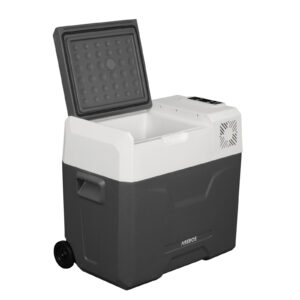
– Arebos 47L compressor cooler running from the 12V cigarette-lighter output
– Starlink Mini usually running over USB-C
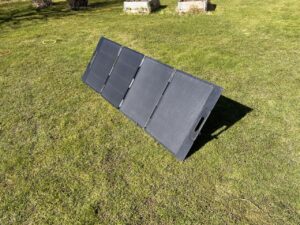
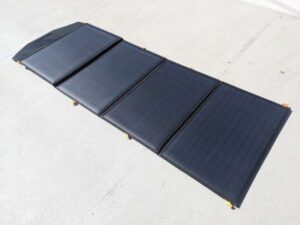
– BLUETTI MP200 providing daytime solar input
That setup has become very predictable for me, and that predictability is a big part of why I trust it.
The cooler is one of those loads that quietly matters all day and all night. It is not flashy, but it changes what food I can bring and how relaxed I feel on multi-day trips. The Starlink Mini is a different kind of constant load, but it matters just as much here because it makes battery capacity and solar recovery feel very real. This is not a setup where I am only topping up phones once in a while.
Most of the time, the Starlink Mini is close enough that I power it over USB-C without thinking much about it. If I need to place the dish farther away, I sometimes use a 12V splitter and a homemade DC-DC converter because of voltage drop over longer cable runs. I mention that only to describe my own setup, not as a recommendation or a how-to.
What I like about the AC180 in this system is that it feels flexible without feeling complicated. I mostly use the DC side of it, but I still like knowing the AC outlets are there if I need them. That is one of the main reasons I still think this size class is so practical.
What battery life looks like for me at camp
This is the part that has mattered most in actual use.
In my normal camping pattern, I start the morning with the AC180 at around 40 to 50%. That is after the Arebos 47L cooler and Starlink Mini have been running through the night and are still connected.
Then, during the day, I connect the BLUETTI MP200 in decent sun. In good conditions, the AC180 usually makes its way back to 100% by later in the day, even while the cooler and Starlink stay connected.
That pattern has been consistent enough that it defines how I use the AC180 now. I do not camp as if I am on a strict one-battery countdown. I camp as if I have a battery that drops meaningfully overnight, then usually recovers during the day if the weather cooperates.
That last part matters. I am describing a pattern I have seen many times, not making a guarantee. Solar is never tidy in real life. Panel angle matters, temperature matters, shade matters, and weather matters. But as an honest summary of how the AC180 behaves in my setup, that morning-to-full-again rhythm is the main reason I have been so happy with it.
It makes the whole system feel sustainable rather than temporary.
Solar charging with the BLUETTI MP200 in real use
One of the easiest mistakes in power-station reviews is to talk about solar as if the panel’s rated number tells the whole story. It does not.
In my use with the BLUETTI MP200, the number I typically see on the AC180 display in good sun is around 170W at first, then more like 140 to 150W once the panel heats up. That feels like the honest, repeatable real-world number for me.
More importantly, that level of input has been enough to matter. In my actual camping use, it is often enough to take the AC180 from that 40 to 50% morning level back to full, while my cooler and Starlink are still attached. That is what makes the MP200 pairing worthwhile to me. The system is not sitting idle while the sun works. It is still doing the job I brought it for.
The other side of that story matters just as much.
On rainy or cloudy days, the MP200 does not do much in my experience. When the weather turns, I stop thinking in terms of daily recovery and start thinking in terms of conservation. That does not mean the setup becomes useless. It just means I have to be more deliberate. I may watch usage more closely, think harder about whether Starlink really needs to stay on continuously, or treat the battery as a finite reserve instead of something that will probably refill itself.
That is one reason I like the AC180’s capacity. It gives me enough reserve that poor solar is a manageable problem rather than an immediate one.
Still, I would not oversell the solar side. My experience has been very good overall, but it is good in a practical, weather-dependent way, not in a “set it out and forget it” way.
Why the AC180 works so well for my camping use
The more I have used the AC180, the more I think its real strength is not any one port or one headline spec. It is that it lands in a very workable middle ground for camp use.
At camp, I want three things from a power station:
1. Enough capacity that I am not nervously checking the display all the time
2. Enough output flexibility that I can run the gear I actually care about
3. A shape and weight that still feel realistic for car-based trips
The AC180 does those three things well for me.
The 1152Wh capacity is enough that my setup feels stable. The 1800W AC output is more than I usually need, but I genuinely like having it available. Even though I mostly run DC loads, the AC side makes the whole unit feel more versatile and less limited. I do not have to think of it as “only for USB and 12V.” It can be the main battery for camp, and that matters.
This is also why I think the AC180 suits base camp much better than true grab-and-go use. Once it is in place, it feels excellent. It becomes the battery everything sensible revolves around. But it does not disappear physically the way a smaller DC-focused unit can. I feel the weight whenever I move it.
Portability: heavy, but manageable near the car
This is probably the clearest tradeoff, and I think anyone considering the AC180 should be realistic about it.
At about 16 kg / 35.3 lb, I definitely notice the weight. In actual use, though, I still find it manageable for setting up camp near the car. Carrying it by the two side handles for about 50 to 100 meters is fine. I would not call that enjoyable, but it is absolutely doable.
That is the key distinction for me.
The AC180 is portable enough for:
– moving from the car to the tent site
– repositioning around camp
– bringing out during a home outage
– short carries where compactness matters more than low weight
It is not the kind of power station I would want if my main priority was:
– true grab-and-go convenience
– frequent longer carries
– something I can move one-handed without thinking
– a battery for more mobile use away from the car
So when I say I like the AC180, I do not mean I think it is easy to carry in some broad sense. I mean the weight has been acceptable for the kind of use it suits best.
Wall charging speed and fan noise
One thing I have consistently appreciated is how easy the AC180 is to charge at home before a trip.
BLUETTI offers Silent, Standard, and Turbo AC charging modes. I use Normal/Standard mode, and from about 50% to full, I usually see something like 1 to 1.5 hours. That is simply very convenient.
A lot of outdoor gear gets judged only by what it does outside, but home usability matters too. I do not want a battery that takes forever to top up before leaving. The AC180 has been the opposite of that. If I am packing for a trip and notice it is half full, I can plug it in and feel pretty relaxed about being ready soon.
There is some fan noise while charging, and I do notice it. I would not call it loud, but it is there. The nice part is that in my normal camping setup, where I am mostly running lower-power DC loads, I get no fan noise at all. That has honestly been one of the nicer parts of living with it at camp. It just sits there and does its job without adding another constant sound to the tent area.
Home outage use: useful, but only in a modest role for me
I have also used the AC180 during a couple of power outages at home, and I think that secondary role fits it well.
In those situations, I connected both my fridge and freezer at the same time for a couple of hours. I also had the MP200 connected in case the outage lasted longer. That worked well for the short period I actually used it that way.
I do want to be careful with the framing here. I have not tested the AC180 through a long outage in a controlled or repeated way, so I do not want to turn a short real-world use case into a bigger claim than it deserves.
That is really my position on home backup with this unit: I think it is a good short-emergency tool and a practical thing to have around, but my own experience is limited and I would not use it as proof of extended outage performance for everyone.
The same caution applies to AC appliances more broadly. I like having 1800W AC output available, and it feels generous. But my review is not based on broad testing of lots of different household devices.
Long-term reliability after about 2 years
After about two years of regular seasonal use, this is one of the easiest sections for me to write.
The AC180 still works like day one in my experience.
I have not had failures, strange behavior, charging issues, or anything else that made me stop trusting it. The unit has picked up a few scratches, which is completely normal given how often it goes in and out of the car and gets moved around camp, but nothing about it feels worn out.
More importantly, I have not noticed battery degradation. I want to phrase that carefully because this is a long-term owner impression, not a lab test. I have not done controlled capacity measurements. I am simply saying that in the way I actually use it, the battery does not feel weaker or reduced compared with when it was new.
That is a big compliment.
Power stations are one of those products where reliability matters more than polished marketing. If I am depending on one to keep food cold, internet running, and camp life comfortable for several days, I need it to feel trustworthy. After two years, the AC180 has earned that trust from me.
The downsides
I like the AC180, but a few weaknesses keep coming up.
The solar input connector does not inspire much confidence
This is my most concrete hardware complaint.
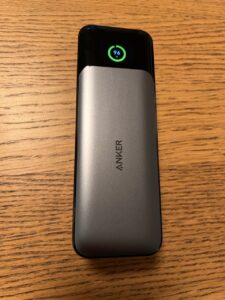
The DC7909-style solar input on the AC180 feels flimsy and less secure than I would like. It works, and I have used it successfully with the MP200 many times, so this is not a failure story. But compared with the XT60 input on my Anker C300 DC, it feels less robust and less confidence-inspiring to me.
That might sound minor until you actually use solar regularly. Solar connections get plugged and unplugged outside, around dust, around movement, and around gear being repositioned. In that context, connector confidence matters.
The app is okay, but Bluetooth range limits it
The BLUETTI app works, and I would still rather have it than not have it. But compared with the Wi-Fi-based app experience on my Anker C300 DC, it feels more limited in practice.
The biggest issue for me is Bluetooth range, which feels weak. If I am near the unit, fine. If I am not, the app becomes much less useful. That reduces its value once the AC180 is part of a real camp layout rather than sitting right next to me.
This is not a deal-breaker, but it is one of the few areas where the AC180 feels less polished than the rest of the ownership experience.
It is still heavy
This has to stay on the downside list no matter how much I think the overall size makes sense. The AC180 is manageable and practical for car camping. It is not light.
Who I think the BLUETTI AC180 is best for
After two years, I think the AC180 makes the most sense for people who want:
– a main battery for car camping
– a base-camp power station near the vehicle
– enough capacity to support ongoing loads instead of just topping up phones
– a setup that is mostly DC-focused, but where having real AC capability is still useful
– a battery that can also help in short home emergencies
That is exactly how I use it, and in that role I think it is very good.
I think it makes less sense for people who want:
– a light grab-and-go power station
– something they will carry far from the car often
– a battery mainly for ultra-portable use
– the smallest possible package above everything else
That does not make the AC180 bad. It just gives it a clear lane.
My bottom line after about 2 years
After about two years of real use, the BLUETTI AC180 has turned out to be one of the better gear purchases I have made for camping.
It has been the center of a camp power system that actually works in a way I can depend on: Arebos 47L cooler on 12V, Starlink Mini usually on USB-C, MP200 solar during the day, and the AC180 usually recovering from around 40 to 50% in the morning back to full by later in the day when the weather is good. That pattern, more than any single test number, is why I still rate it highly.
I also like that it is useful beyond camp. Fast wall charging makes it easy to live with at home, and it has already been handy during short power outages. At the same time, I do not want to exaggerate what I have actually tested. My home-outage use has been limited, and my AC appliance testing has been limited. What I trust most here is the camping side, because that is what I have done repeatedly for two years.
If you want the simplest answer to whether I would buy it again for my own use, it is yes.
I would buy it again because it gets the important things right for me: enough capacity, enough flexibility, fast charging at home, silent behavior in my normal DC-heavy camp setup, and reliability that has stayed reassuring over time.
I would also buy it again knowing the tradeoffs: the weight is real, the solar input connector could be better, and the Bluetooth app experience is only average.
So my conclusion is simple. If your use case looks a lot like mine — car camping, tent-site power, a compressor cooler, Starlink Mini, solar during the day, and mostly DC-heavy use — I think the BLUETTI AC180 is easy to recommend.
If you mainly want something light and easy to grab with one hand, I do not think this is the right power station.
Bluetti AC180
The BLUETTI AC180 has been a reliable and very capable power station in my camping setup after about two years of real use. It works especially well for car camping and base-camp use, where it can run ongoing loads like a compressor cooler and Starlink Mini while recovering well from solar on good days. It charges quickly at home, stays quiet in my normal DC-heavy setup, and still feels as dependable as when it was new. The main downsides are the weight, an only-average app experience, and a solar input connector that feels less robust than it should.
Pros
- Reliable after 2 years of use
- Fast wall charging
- Good real-world solar recovery
- Quiet in normal DC-heavy use
- Strong fit for car camping
- Useful AC and DC flexibility
Cons
- Heavy to carry
- Bluetooth app range is limited
- Solar input feels flimsy
- Less suited to true grab-and-go use
- Cloudy weather reduces solar usefulness
Best for
Car campers, tent-site setups, base-camp use near the car, users running a cooler and Starlink Mini, and anyone wanting a mid-size power station with solid capacity, fast charging, and useful AC backup.
Not for
People who want a light grab-and-go power station, need to carry it far from the car often, or prioritize the smallest and easiest-to-move setup above all else.