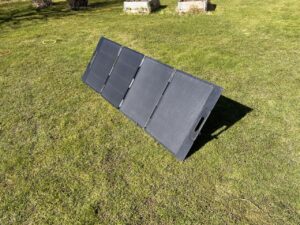
The simplest way I can describe the BLUETTI MP200 is this: it is not a hiking panel. It is a panel I keep in the car, unfold near camp, point at the sun, and let work for hours.
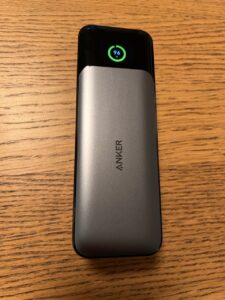
That difference matters, because it really shapes how I feel about it after about two years of use. I have mostly used the MP200 during the warmer months while camping, and occasionally at home during power outages. Most of the time I pair it with my Bluetti AC180 to keep my main camp battery topped up. If the AC180 is already full, I sometimes switch over and use the MP200 to charge my Anker C300 DC instead. My Starlink Mini and compressor cooler are part of that broader setup too, so this review comes from a system I have actually lived with, not just tried once or twice.
What has kept me using the MP200 is not the idea of a 200W panel on paper. It is that the panel is easy to set up, feels solid, and gives me genuinely useful charging over a real day outside. The tradeoff is obvious too: for a folding 200W panel, it is heavy, and I would not recommend it to anyone looking for lightweight solar.
The short version
If you want the quick take before the details, this is where I stand after about two years:
– Best fit in my experience: car camping, base camp, and home-backup use
– Poor fit: hiking, backpacking, or any setup where weight matters a lot
– Real output I often see: around 170W at first on the AC180 display, settling closer to 150W as the panel heats up
– Best charging result I have seen: AC180 from roughly 20-30% to full in about 5-6 hours on a clear summer day, while it was also powering a compressor cooler and a Starlink Mini
– Biggest strengths: easy setup, sturdy build, and useful real-world output
– Biggest downside: weight, especially for the power you get
That is basically the whole review in one line: I like the MP200 a lot for stationary use near the car, but I like it because I use it as a base-camp panel, not because it is especially portable in the hiking sense.
BLUETTI MP200 specs, size, and portability
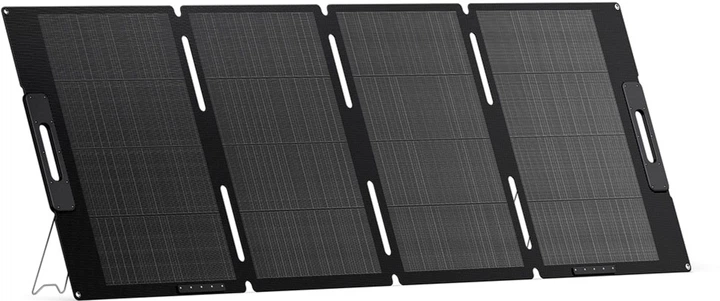
According to BLUETTI’s published specs, the MP200 is a 200W monocrystalline folding solar panel with ETFE lamination. BLUETTI lists the weight at 8.7 kg / 19.1 lb and the folded size at 681 x 553 x 65 mm.
Those numbers tell you pretty quickly what kind of product this is.
This is a folding camp panel, not an ultralight backpacking panel, and that is exactly how it feels in use. I do not think of it as something I carry long distances. I think of it as something I take out of the car, carry a short distance to a sunny spot, and leave there to do its job.
If that is the kind of solar setup you want, the size and weight make sense. If you want something you can throw in a hiking pack without thinking twice, the MP200 is the wrong tool for that.
How I use the BLUETTI MP200 for camping and home backup
Most of my use is pretty straightforward.
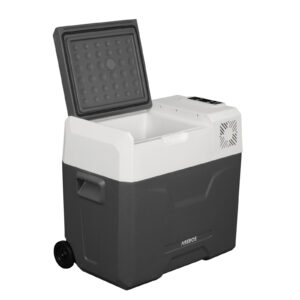
At camp, the MP200 usually feeds my Bluetti AC180. That is the main battery I want to keep ready because it supports the gear that actually matters to me, especially my compressor cooler and Starlink Mini. Those are the kinds of loads that can quietly wear a battery down over the course of a day, so having solar helping in the background makes a real difference.
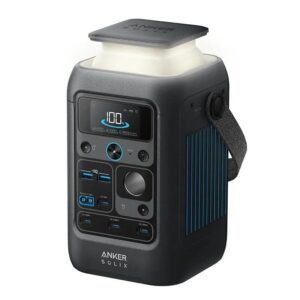
If the AC180 is already full, I sometimes use the MP200 to top up my Anker C300 DC instead. That works well for me because the C300 DC covers lighter jobs, while the AC180 stays as my main camp battery.
I have also used the MP200 at home during power outages, though I do not want to oversell that side of it. For me, this is not about pretending that one folding panel and one battery restore normal life. It is more practical than that. If the sun is out, the MP200 gives me a way to put power back into the AC180 so it is easier to support essentials like the fridge and freezer. Even if an outage is fairly short, that extra input can help stretch runtime and reduce battery drain.
That is really how I think about the MP200 overall: not as a quick opportunistic charger, but as a stationary solar source for a small, practical off-grid setup.
Setup and ease of use
One of the main reasons I keep bringing the MP200 is that it is so easy to deploy.
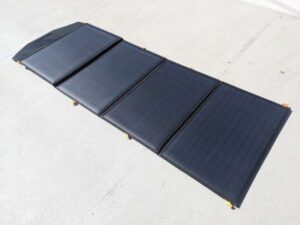
I unfold the four sections, put the kickstands out, aim it at the sun as well as I can, and plug it into the power station. That is basically the whole process. There is nothing especially complicated about it, and in real use that matters more to me than a lot of spec-sheet talk.
At camp, I do not want solar to feel like another project. I want to set it up near the car and move on with the day. The MP200 is simple enough that I actually use it instead of putting it off.
The same thing applies during outages at home. If the power is out, I do not want backup gear that feels fiddly or annoying. The MP200 is easy enough that I am happy to set it up early, even if I am not sure how long the outage will last. That is a real strength. Backup gear only helps if I actually use it.
Real-world charging performance with the Bluetti AC180
This is the part that matters most to me.
I have not tested the AC180 from completely empty to full with the MP200, so I am not going to pretend I have that number. What I can say is what I have seen often enough in real use that I trust it.
In good sun, I have often seen the MP200 start around 170W on the AC180 display, then settle closer to 150W once the panel has been sitting in strong sun and warmed up. That feels like an honest description of how it behaves in my setup, and I would much rather report that than act like the 200W rating should appear all day.
The best result I have seen was on a clear summer day, with the panel angled toward the sun and repositioned about once an hour. In those conditions, I took my AC180 from roughly 20-30% to full in about 5-6 hours while it was also powering a compressor cooler and a Starlink Mini.
That result impressed me, but I want to frame it carefully. I do not see it as a guaranteed charging time or something everyone should expect in all conditions. I see it as a strong real-world result from a very good day: clear weather, decent sun, active repositioning, and the kind of loads I actually care about.
Even with that caution, it was the result that really sold me on the panel. The AC180 was not sitting there idle. It was running real gear while the MP200 fed it, and the battery still got back to full later in the day. That feels genuinely useful to me.
How heat and cloud cover affect MP200 output
None of this will be surprising if you have used portable solar before, but it is still worth stating clearly.
Heat affects output. In my use, the MP200 often starts higher and then drops from around 170W toward 150W after sitting in strong sun for a while. I do not see that as some strange flaw. I see it as normal real-world behavior.
Cloud cover matters too. In cloudy or mixed conditions, output drops, sometimes quite a bit. The panel still produces power, but much less than it does on a clear summer day. Because of that, I would never plan around fixed charging times unless the weather is actually cooperating.
That is also why my 5-6 hour AC180 result should be read as a good-day example, not a promise. It shows what the panel can do in favorable conditions, not what it will do every time.
Build quality after 2 years
If performance is why I keep using the MP200, build quality is a big part of why I trust it.
After about two years of occasional use, it has held up well. The overall impression is that it feels sturdy. It does not feel delicate, and it does not feel like something I have to baby every time I take it in and out of the car.
I also like that the kickstands are metal. The one detail that gave me a little pause at first was the plastic connection between the kickstand and the panel. When the MP200 was new, that looked like a possible weak point to me.
So far, though, it has not actually been a problem. I cannot promise that it never will be, but in my use it has held up fine. It worried me more in theory at the beginning than it does now in practice.
This is also one of the places where the MP200’s weight makes a bit more sense to me. I do think some of that heft comes from a more rugged build. If you care more about sturdiness and straightforward use than chasing the best possible watts-per-kilo number, I can see the logic in BLUETTI’s design.
Weight, portability, and who should avoid it
My main criticism of the MP200 is very simple: it is heavy.
I do not mean it is impossible to move. It is easy enough to take in and out of the car, carry a short distance, and set up near camp. But it is not something I would want to carry far, and definitely not something I would bring on a hike just because it folds.
That is the difference, for me, between “portable” in marketing language and portable in the way I think about outdoor gear.
In practice, it is portable enough for:
– taking in and out of the car
– carrying a short distance
– setting up near camp
– using at home during an outage
It is not the kind of panel I would choose for:
– hiking
– backpacking
– any setup where I am trying hard to keep weight down
And for me, the issue is not just the raw weight. It is also the power-to-weight ratio. I understand why the panel feels sturdy, and I do think that ruggedness is part of the appeal, but if your top priority is getting the most wattage for the least weight, I do not think this is the obvious choice.
That is why I keep coming back to the same conclusion: this is a car-camping or base-camp panel, not a hiking panel.
Why it works well in my camp setup
The MP200 makes the most sense when I think of it as one part of a larger system rather than the star of the show.
My AC180 is the main battery I want ready. My compressor cooler is one of my most important ongoing loads. My Starlink Mini adds another steady draw that makes solar feel genuinely useful rather than optional. And my Anker C300 DC gives me a second battery I can top up when the AC180 is already full.
In that context, the MP200 fits very naturally. It is easy to deploy, productive enough to matter over several hours, and sturdy enough that I do not mind bringing it along regularly. That is what I want from a base-camp solar panel. I do not need it to be tiny. I need it to be worth setting up, and in my use it has been.
I also think it makes more sense for someone who already knows they want a stationary solar setup near camp or near home than for someone hoping one panel will cover every kind of trip. The MP200 feels strongest when the job is clear: set it up, keep a nearby power station fed, and let it work over time.
Who the BLUETTI MP200 is best for
After using it for about two years, I think the MP200 makes the most sense for people who want:
– a folding solar panel for car camping or overlanding
– a base-camp solar setup near their vehicle
– a good match for a nearby power station like the Bluetti AC180
– a simple solar helper during outages
– something that feels rugged and straightforward
I think it makes less sense for people who want:
– a panel for hiking or backpacking
– the lightest possible setup
– the highest wattage-per-kilo
– output close to the rated number in every condition
Is the BLUETTI MP200 worth it?
For me, yes, but only because I think it is good at the job I actually ask it to do.
I like the MP200 as a base-camp solar panel and as a practical home-backup helper. Over about two years, it has been easy to deploy, solidly built, and useful enough to keep earning space in my gear. In good conditions, I have often seen around 170W at first on the AC180 display, dropping closer to 150W once the panel gets hot. And on a clear summer day, with the panel angled toward the sun and repositioned about once an hour, I have had it take my AC180 from roughly 20-30% to full in about 5-6 hours while the AC180 was also running a compressor cooler and a Starlink Mini. I see that as a strong real-world result, not a promise, and that kind of performance is what makes the panel feel worthwhile to me.
The downside is just as clear: it is heavy, and I do not think it makes sense as hiking gear.
So my bottom line is simple. If your use case looks like mine—keeping a power station charged near the car, supporting camp gear, maybe topping up a smaller battery like the Anker C300 DC when the main battery is already full, and having a solar option ready for outages—I think the BLUETTI MP200 is easy to appreciate.
If you want a light panel to carry on foot, I would look elsewhere.
Where to Buy
-
Bluetti MP200View at Amazon SE
-
Bluetti MP200View at Amazon US
BLUETTI MP200
The BLUETTI MP200 is a sturdy and easy-to-use 200W folding solar panel that has worked well for me over about two years of camping and occasional home-backup use. In real conditions, it has given me genuinely useful charging for a nearby power station, especially with my Bluetti AC180, and it is simple enough that I actually use it regularly. Its biggest strength is that it works well as a stationary camp or backup panel. Its biggest weakness is weight, which makes it a poor fit for hiking or any setup where portability matters a lot.
Pros
- Very easy to set up
- Useful real-world charging output
- Solid and sturdy feel
- Good fit for car camping
- Works well with nearby power stations
- Practical for home backup
Cons
- Heavy for a 200W folding panel
- Poor fit for hiking and backpacking
- Output drops with heat
- Cloudy weather reduces performance
- Not great watts per kilo
Best for
Car camping, base-camp solar setups, overlanding, pairing with a nearby power station like the Bluetti AC180, and simple home-backup use during outages.
Not for
Hiking, backpacking, long carries on foot, ultralight setups, or buyers who mainly want the best possible power-to-weight ratio.