I wanted a simple, clean answer: if I start my BLUETTI AC180 at 0% and give the BLUETTI MP200 a full six-hour afternoon in clear April sun, what does that actually look like?
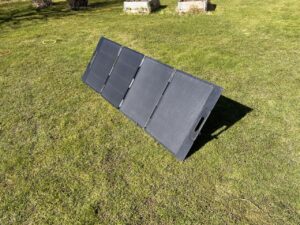
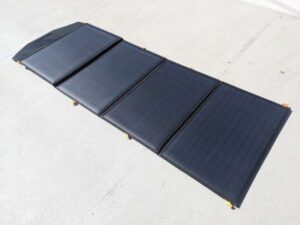
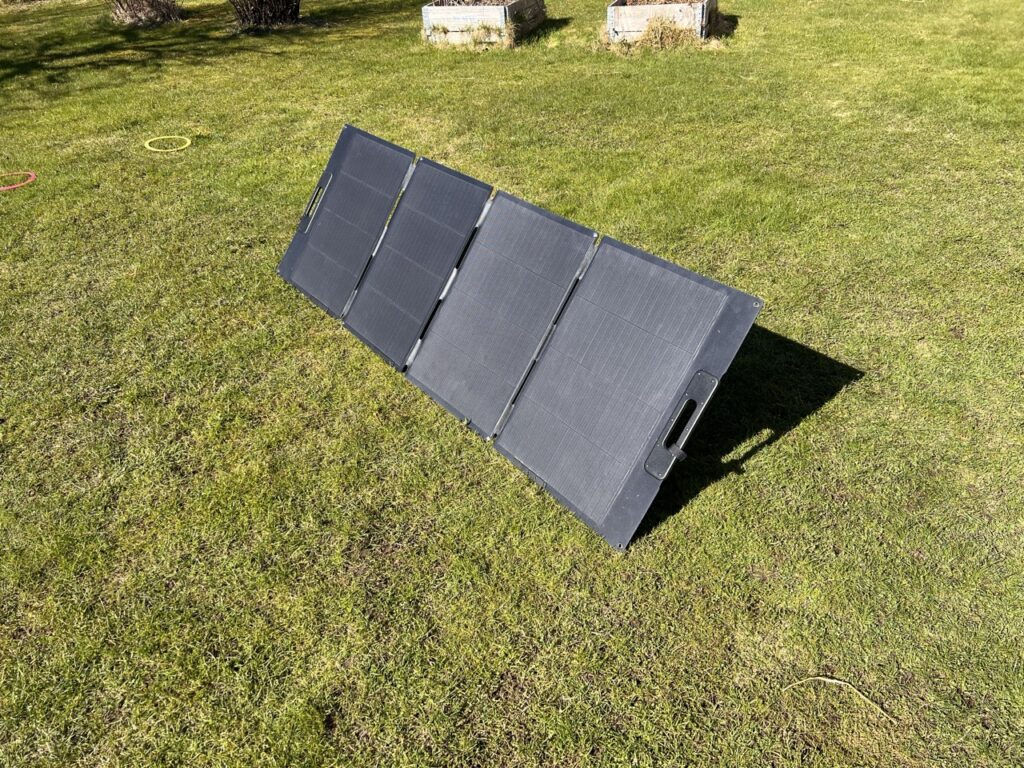
So I set the panel up on the lawn, propped it up with the built-in kickstands, connected it with the supplied MC4 to DC7909 cable, and let it charge from 12:00 to 18:00. There was no shade, no cloud cover, and no obstructions, and the AC180 was only charging with no loads running.
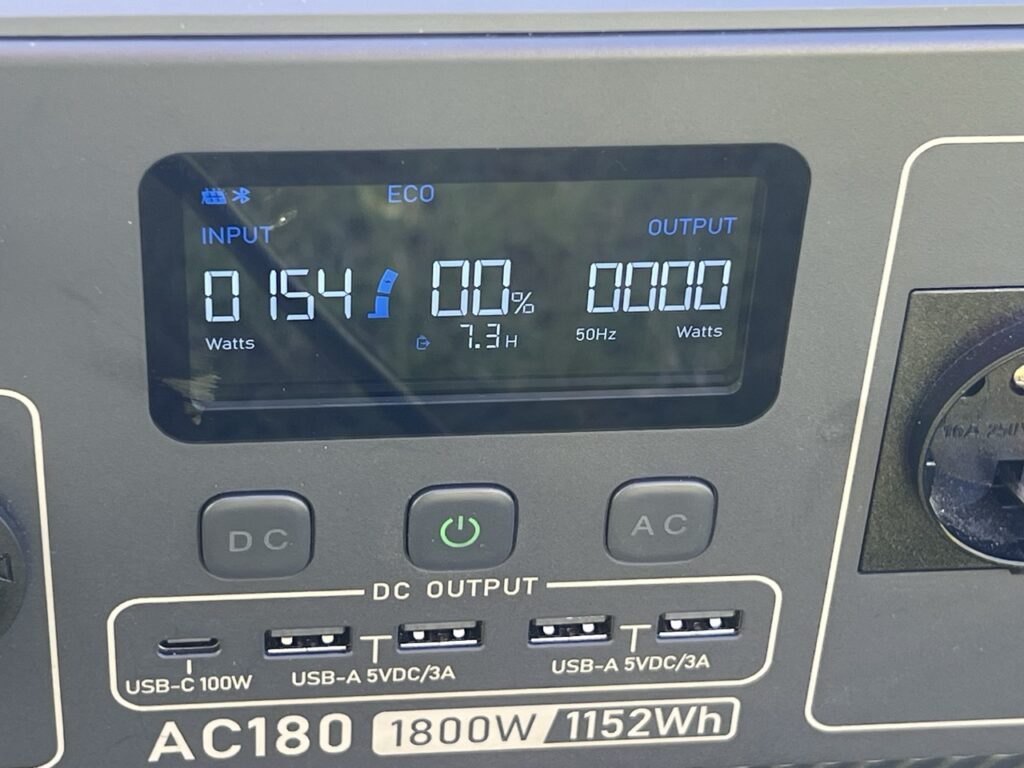
The short version is easy enough: the result was useful, but it was still worse than I expected. Input sat at around 140W for most of the session, peaked at 154W, and by 18:00 the AC180 display read 73%.
The short version
If you want the quick takeaway before the details, this is what this field test showed me:
– Test time: 12:00 to 18:00
– Starting point: AC180 at 0%
– Conditions: clear April sun, no shade, no cloud cover, no obstructions
– Setup: panel on the lawn, using the kickstands, connected directly with the supplied MC4 to DC7909 cable
– AC180 load: none — it was only charging
– Typical input: around 140W
– Peak input: 154W
– Panel repositioning: 5 times
– End result at 18:00: 73% on the AC180 display
That is a meaningful result from empty, but it was also clearly short of the full charge I had hoped to see.
Why I ran this test
I wanted a cleaner answer than I usually get in normal use.
Most of the time, when I use the MP200 with the AC180, the power station is also doing real work. It might be supporting camp gear, and that makes it harder to isolate what the panel itself is really contributing. This time I wanted to remove that variable and see what a straightforward solar-only charging session looked like.
On paper, a 200W panel charging a 1152Wh power station makes a same-afternoon full charge sound plausible. But that kind of paper math assumes sustained nameplate output and does not account for real-world charging losses, angle changes, or taper. I wanted to see what the pairing actually did outside, not what the specs suggested in theory.
The setup was about as fair as I could make it
If I wanted to give the MP200 a fair chance, this was a pretty good way to do it.
I placed it on the lawn in full sun, used the kickstands to angle it toward the sun, and repositioned it five times over the course of the session. There were no clouds, no shade, and no nearby obstructions working against it.
The connection was simple too. I used the supplied MC4 to DC7909 cable straight into the AC180, with no extra complication in the setup.
Just as importantly, the AC180 was not powering anything during the test. It was only taking charge. That makes this result easier to interpret than a normal mixed-use day.
What the MP200 actually delivered
The charging session ran from 12:00 to 18:00, and the main pattern was steadiness rather than dramatic swings.
For most of the session, the AC180 showed around 140W coming in. The highest number I saw was 154W, and that happened after I had repositioned the panel. Each adjustment gave input a small lift, sometimes pushing it above 150W, but it never stayed there for long. The usual pattern was a brief bump and then a return to roughly 140W.
By 18:00, the AC180 display showed 73%.
That is the full result of this test: six clear hours, no loads, no shade, no clouds, no obstructions, and a final display reading of 73%.
Why the result still felt disappointing
I do not think this was a bad result in absolute terms. Taking an AC180 from 0% to 73% in one afternoon is still a meaningful recovery.
But I also came away disappointed.
The reason is simple: I had gone into the test expecting this setup to have a decent shot at doing more. When I look at a 200W-rated panel and a 1152Wh power station, it is easy to imagine that a full recharge in something like this timeframe should be possible in very good conditions.
This test was a useful reminder that real solar does not behave that neatly.
The MP200 did not spend the day anywhere close to 200W. It spent most of the time at about 140W, and only briefly moved above 150W after I adjusted it. Once I looked at the session that way, the outcome made more sense, even if I still wished it had been better.
Repositioning helped, but only to a point
One of the clearest takeaways from this test is that repositioning mattered.
I moved the panel five times, and the best input numbers came right after those adjustments. So yes, aiming the panel properly helped. If I had left it in one position all afternoon, I suspect the result would have been weaker.
At the same time, repositioning did not transform the test. It improved the peaks, but it did not turn this into a sustained 180W or 190W charging session. The practical reality was still the same: around 140W most of the time.
That is useful to know. The MP200 benefits from attention, but attention alone does not erase the gap between rated output and what I actually saw over six hours.
What I liked about the MP200 in this test
Even though the end result was weaker than I hoped, I still liked a few things about using the panel.
The kickstands worked well
The kickstands made setup easy and made those five adjustments straightforward. That matters, because a panel that is annoying to reposition is a panel I am less likely to manage properly over the course of the day.
The panel felt stable
Once set up on the lawn, the MP200 felt stable. It did not feel flimsy or fussy, and I did not feel like I had to keep babysitting it just to keep it standing.
The connection was simple
I also liked the simplicity of using the supplied MC4 to DC7909 cable directly with the AC180. It kept the whole test clean and uncomplicated.
The main downside is still the weight
The biggest downside for me is still the same one: the MP200 is heavy.
That does not stop it from making sense for lawn use, car camping, or base-camp solar. In fact, the stability and kickstand setup are both positives once it is in place. But the weight is still part of the story, and it is the thing I notice most on the negative side.
So while I liked how stable it felt during the test, I still would not describe it as a panel that feels light or especially easy to move around.
Bottom line
This field test gave me a clearer answer than paper specs did.
In clear April sun, with no shade, no cloud cover, no obstructions, five panel repositionings, and no loads on the AC180, the BLUETTI MP200 delivered around 140W most of the time, peaked at 154W, and took the AC180 from 0% to 73% between 12:00 and 18:00.
That is a useful real-world result, but for me it was still worse than expected.
My practical takeaway is simple: I like the stability, I like the kickstands, and I like how easy the setup is. But if you are looking at this pairing and assuming a 200W folding panel will automatically fill an empty AC180 in one sunny spring afternoon, this test did not support that.