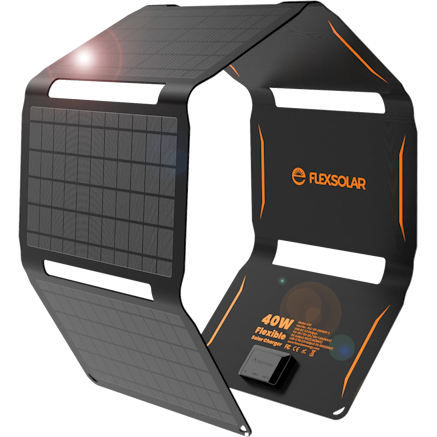
After about three years with the FlexSolar 40W, I think I understand exactly why it has stayed in my hiking kit: it solves a small problem well.
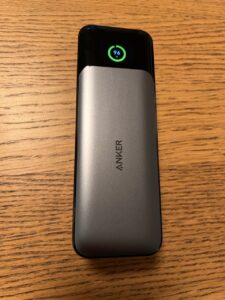
I do not use it for big off-grid ambitions. My typical use is much simpler than that. I bring it on lightweight hikes, usually when I am sleeping in a 2-person tent for a night or so, and its main job is to charge my Anker 737 during the day. Then, at night, I use that battery bank to charge my phone while I sleep.
That workflow has been the real key for me. The panel is not there to power everything directly in real time. It is there to gather enough energy during the day that camp feels easier at night.
And in that role, it has worked well.
I have seen around 30 to 35W in full summer sun with near-perfect alignment, which is respectable from a panel this size. But I have also used it long enough to know where the limits are. If I want output to stay up, I need to pay attention to positioning. Clouds will pull it down. Hanging it from a backpack while walking can collect a little sunlight, but not enough to pretend it replaces proper setup time at camp.
So my view after three years is pretty settled: for small, realistic power needs, this panel has made sense for me. For charging a larger power station or supporting heavier energy use, I do not think it is the right tool.
Quick verdict
If you want the short version, this is where I land:
– I have used the FlexSolar 40W for about three years
– My normal use is lightweight overnight hikes with a 2-person tent
– Its main job is charging an Anker 737 during the day, then letting that battery bank handle phone charging at night
– In very good summer conditions, I have seen around 30 to 35W
– It is portable enough that I still bring it
– Setup is basically unfold it and prop it toward the sun
– My main annoyances are the lack of kickstands and stiff panel joints until they warm up
– I think it is very good for smaller power needs
– I do not think it is a good fit for charging a larger power station
The job this panel actually does for me
What I wanted from this panel was not unlimited power. I wanted breathing room.
Without something like this, short trips can turn into an annoying choice: either carry more battery than I want, or start treating normal phone use like a resource emergency. I was looking for a middle ground where I could keep my setup light, still use my phone normally enough, and not spend the whole trip thinking about percentages.
That is the role the FlexSolar 40W has filled.
In real use, I treat it as a daytime charger for the Anker 737, not as a panel I constantly plug directly into whatever device I am using. That makes the whole setup more practical. I collect energy while there is sun, store it in the battery bank, and then use that power later when I actually need it.
On some trips, that just means keeping my phone topped up overnight. On others, I might also charge a flashlight or lantern, or watch some YouTube or a movie before sleeping. Very occasionally, on trips without cell coverage, I may also use the Anker 737 to power a Starlink Mini for a while. But that is very much the exception. The main use case is still simple: solar by day, battery bank by night.
That is also why I like this panel more than I would like a weaker or more awkward setup on paper. It fits the scale of what I am actually doing.
Portability and setup: why I still bring it
A portable solar panel only matters if I keep choosing to bring it.
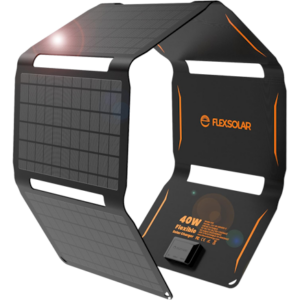
On my unit, the folded size is roughly 20 x 30 x 5 cm by my own rough measurement, and it feels very portable to me at about 1.3 kg. That is not nothing in a hiking kit, and I would not pretend otherwise. But it has stayed comfortably on the useful side of the line for me. It is compact enough to pack without reorganizing everything around it, and light enough that I still think it earns its place on the kind of overnight trips I actually do.
That matters more than specs sometimes suggest. A panel can be perfectly respectable on paper and still be annoying enough that it gets left at home. This one has not crossed that line for me.
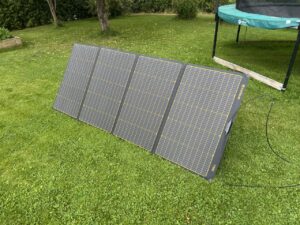
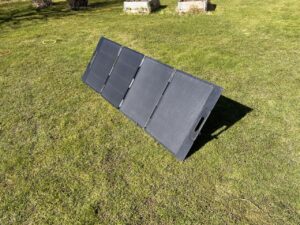
Setup is also about as simple as I could ask for. I basically unfold it and prop it against something toward the sun. That is most of the routine. At camp, I usually lean it against gear, a rock, or whatever else makes sense nearby. There is no complicated process to it, which is a big part of why it works for me.
I do sometimes hang it from my backpack while walking, just to gather a bit of sunlight on the move. But I do not think that should be oversold. In that position, it only catches a little sunlight. It is a small bonus, not a serious charging strategy. If I want meaningful output, I still need to stop and give it a better angle.
Charging performance in real use
This is where expectations need to stay realistic.
In full summer sun, with the panel lined up very well, I have seen around 30 to 35W. That is the best result I have personally seen, and I do think it is a solid result for a small foldable panel like this. But I would not treat that as the everyday baseline.
To stay near that level, repositioning matters. If I want strong output, I need to keep the panel facing the sun reasonably well. When I do not, the number drops. Clouds also make output dip, sometimes pretty quickly. None of that is unusual for portable solar, but it does define how useful a panel feels in practice.
That is one reason I think this panel makes the most sense when paired with a battery bank. Solar is variable. A battery smooths that out.
I also pay attention to campsite placement more than I used to. I often camp near a lake, and when I can, I try to stay on the side with evening sun. That extra stretch of usable light can make a real difference with a panel this size. It is not about chasing perfect conditions all day. It is just about giving the panel enough decent sun over time to do useful work.
And that is really how I judge it now. Not by whether it can hit a nice number for a moment, but by whether it gathers enough energy across a normal day to make my overnight setup feel easier. For me, it has.
How it fits with my Anker 737 at camp
This is the part that matters most to me, because it is where the panel stops being interesting and starts being useful.
My normal pattern is very steady by now: the FlexSolar 40W charges the Anker 737 during the day, and then the Anker 737 handles my phone at night. That simple handoff is why the system feels so workable. I am not depending on the panel at the exact moment I need power. I am using it to refill the battery bank ahead of time.
In practice, that gives me the kind of margin I was hoping for when I bought it.
By bedtime, the Anker 737 is usually back in a comfortable place after normal overnight phone use from the previous night, often with enough margin for another overnight phone charge and sometimes some extra use as well. That extra use might be topping up a flashlight or lantern, or watching a bit of YouTube or a movie before sleeping.
That is the real value of this setup for me. It does not create luxury-camp power. It just makes a one-night or short trip feel more relaxed.
The rare Starlink Mini use fits into that same logic. On trips without cell coverage, I may occasionally use the Anker 737 to power a Starlink Mini for a while. But I do not think of the FlexSolar 40W as a Starlink panel. That would be the wrong way to frame it. In my real use, its job is still helping the battery bank recover enough that I have options later.
The annoyances I still notice after 3 years
I like this panel, but I do have a couple of recurring complaints.
The first is the lack of kickstands. Since aiming matters, built-in support would make the panel easier to place and easier to keep at a decent angle. As it is, I usually have to improvise by leaning it against whatever is nearby. That works, but it is not especially elegant, and sometimes it takes a little fiddling to get it where I want.
The other annoyance is that the joints between the panel sections can feel stiff until they warm up in the sun. When the panel is cool, they can want to fold back more than I would like. Once they warm up, it tends to get better. It is not a major problem, but it is one of those small ownership details that I still notice.
Beyond that, most of what limits this panel is simply the reality of a small solar panel. It needs decent sun. It rewards decent placement. And it works best when the rest of your setup is modest enough that the energy it collects actually goes somewhere meaningful.
Who I think it suits, and who should skip it
I think the **FlexSolar 40W** makes the most sense for people whose needs are close to mine:
– short, lightweight hikes
– overnight camping
– a phone-centered setup
– a battery-bank workflow
– maybe a few extra small electronics beyond the phone
– realistic expectations about what a small panel can and cannot do
In that lane, I think it is very good.
What I would not buy it for is charging a larger power station or trying to support much bigger energy use. Could it contribute a little? Of course. But that is different from being a good fit. If your power demands are significantly above phone charging, a battery bank, and a few small extras, I think this panel will start to feel too limited.
I also would not recommend it to someone who wants a hands-off solar experience. If you want the best from it, you do need to care where you put it and adjust it now and then. That has never bothered me much, but it is part of the deal.
Final verdict
After about three years of ownership, I still think the FlexSolar 40W is a good product with a very clear boundary around it.
For the kind of trips I actually take – lightweight hikes, a 2-person tent, usually a night or so, and a small electronics setup built around an Anker 737 – it has been a genuinely useful piece of gear. It is portable enough that I keep bringing it, simple enough that I can set it up in seconds, and capable enough in good sun to make my overnight power situation feel comfortably manageable instead of tight.
That is really the best way I can describe its value. It does not transform camp life. It just takes the pressure off.
And after three years, that is exactly why I still like it.
If your goal is similar – collect solar during the day, bank it, and have enough power at night for your phone and a few small extras – I think the FlexSolar 40W is easy to like. If you want something to feed a larger power station or support much heavier use, I would look elsewhere.
FlexSolar 40W
A compact and practical solar panel that works very well for small, realistic power needs like charging a power bank on lightweight overnight hikes. Real-world output can be impressive for its size in good summer sun, but it needs decent positioning and is not the right choice for larger power stations or heavier energy use.
Pros
- Portable enough to bring on lightweight overnight hikes
- Simple setup: unfold and point toward the sun
- Respectable real-world output in strong sun
- Works well with a power-bank-based charging workflow
- Good fit for phones and other small electronics
- Helps take pressure off battery management at camp
Cons
- No built-in kickstands
- Needs repositioning for best performance
- Output drops quickly with clouds or poor angle
- Panel joints can feel stiff when cold
- Not suitable for charging larger power stations efficiently
Best for
Lightweight hikers, overnight camping, 2-person tent trips, phone-focused setups, charging a power bank during the day, and small electronics like flashlights or lanterns.
Not for
People wanting to charge a larger power station, run heavier off-grid setups, or get a hands-off solar experience without caring about panel placement.